





Yes. The airport supports all aircraft types, but operations require coordination due to traffic density.
Private Jet Access to O'Hare International Airport
Zero compromise. Absolute precision. Cost effective.

our services
At O’Hare, Capacity Exists. Timing Decides Everything.
O’Hare can accommodate any private jet currently in operation. What it does not offer is operational neutrality.
Aircraft do not arrive here on demand. They enter a system that is already in motion.
Private jet flights into O’Hare are absorbed into one of the most active traffic environments globally, where every arrival is sequenced, and every departure is timed against a constant flow of movements.
From a planning standpoint, the aircraft is rarely the deciding factor. The usable window is.
Our aviation specialists at Zadra Aviation Charter structure each flight around that window, balancing arrival timing, ground availability, and onward logistics to avoid unnecessary delay.

Airport Overview
O’Hare International Airport sits at the core of Chicago’s aviation network and functions as a global transit point rather than a simple destination airport.
Located northwest of the city, it connects long-haul and domestic traffic across multiple continents.
What defines O’Hare is not its size, but how it operates:
- Continuous movement across parallel runways
- Airline-driven traffic peaks
- A system designed for throughput rather than flexibility
Private aviation does not operate alongside this system. It operates inside it.
General facts about O'Hare International Airport
| Fact | Details |
|---|---|
| ICAO Code | KORD |
| IATA Code | ORD |
| Location | Chicago, Illinois, USA |
| Distance to Downtown | ~27 km |
| Elevation | ~680 ft |
| Runways | 8 |
| Longest Runway | ~3,962 meters |
| Airport Type | International Airport of Entry |
| Operating Hours | 24 hours |
Private Aviation at O'Hare International Airport
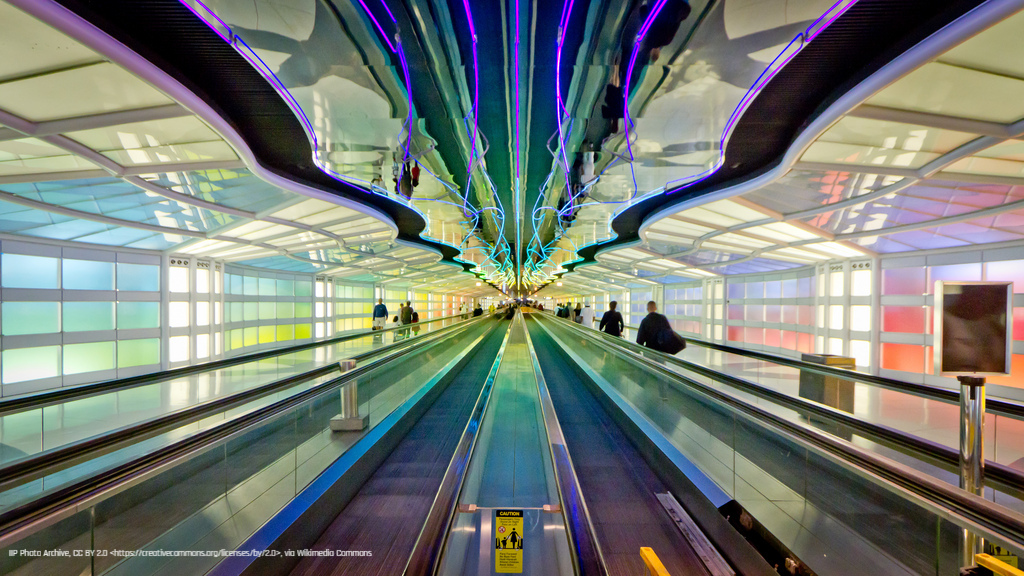
Dedicated FBOs
Signature Aviation Chicago O’Hare provides business aviation handling within O’Hare.
The FBO creates a controlled environment on the ground, separating passenger experience from the broader airport flow.
Handling operations include:
- Aircraft positioning within limited ramp space
- Passenger processing through private facilities
- Fueling and servicing are aligned with narrow timeframes
- Crew coordination and operational support
From an operational perspective, the FBO simplifies ground procedures but does not influence airside constraints.
Efficiency still depends on when the aircraft arrives relative to traffic density.
Our aviation specialists at Zadra align handling schedules with optimal arrival timing to maintain continuity between landing and departure.

Runway Capabilities
O’Hare’s runway system is extensive, allowing simultaneous operations across multiple directions.
The longest runway extends to approximately 3,962 meters, supporting all aircraft categories, including ultra-long-range jets.
From a technical standpoint, there are no limitations.
What defines runway access is:
- Continuous sequencing of arrivals and departures
- Interaction between parallel traffic flows
- High movement frequency throughout the day
Aircraft performance does not limit access. Traffic integration does.

Why Charter to O’Hare
O’Hare is chosen for what it enables, not how it operates.
It provides direct access to Chicago’s business and financial districts while accommodating aircraft that smaller airports cannot.
From a practical standpoint, it becomes the preferred option when:
- Aircraft capability requires a major airport
- International arrivals need a full infrastructure
- Routing efficiency aligns with a primary hub
Clients selecting O’Hare prioritise reach, scale, and connectivity over simplified operations.

Ground Transportation
Ground movement from O’Hare connects directly to Chicago’s transport network.
Transfers to downtown typically take between 30 and 60 minutes, depending on traffic conditions.
Available options include:
- Chauffeur-driven vehicles
- Rail connections via the city’s transit system
- Direct highway access through major expressways
For time-sensitive travel, helicopter transfers can reduce ground travel significantly.
Our aviation specialists at Zadra coordinate ground logistics alongside flight planning to ensure a continuous journey beyond arrival.
Private Aviation at O'Hare International Airport
Integration into a high-volume air traffic system.
Yes. O’Hare fully supports heavy and ultra-long-range aircraft.
Smaller airports offer simpler operations, but O’Hare provides greater capability and international access.
Yes. However, traffic intensity varies throughout the day and affects operational efficiency.

Trusted by our clients
4.9 / 5
Based on 1,328 verified reviews
Geneva 
ZUG
 A Swiss-Based Company
 Go Top