





Yes. The airport supports private jet operations, particularly for light, midsize, and selected super midsize aircraft.
Private Jet Charter to and from Toulon–Hyères Airport (LFTH)
Nessun compromesso. Precisione assoluta. Conveniente.

our services
Toulon–Hyères Airport (LFTH) occupies a very particular position within the French Riviera aviation landscape. While often overshadowed by larger hubs such as Nice, it offers a fundamentally different operating environment, one that prioritises efficiency, discretion, and proximity over scale.
For private jet travellers, Toulon–Hyères represents a more controlled point of entry into the western Côte d’Azur. It allows direct access to Saint-Tropez, Hyères, and the Var coastline without the structural congestion that defines busier airports along the Riviera.
From an operational standpoint, the airport functions as a balanced system. Traffic levels remain moderate, ground movements are predictable, and handling is typically more responsive. This creates a setting where flight planning can be executed with a higher degree of precision and fewer external constraints.
Our aviation specialists at Zadra Aviation Charter approach each flight into Toulon with a focus on alignment. Aircraft selection, routing, and timing are all calibrated against real-time operating conditions, ensuring that each mission reflects not just feasibility, but operational clarity.
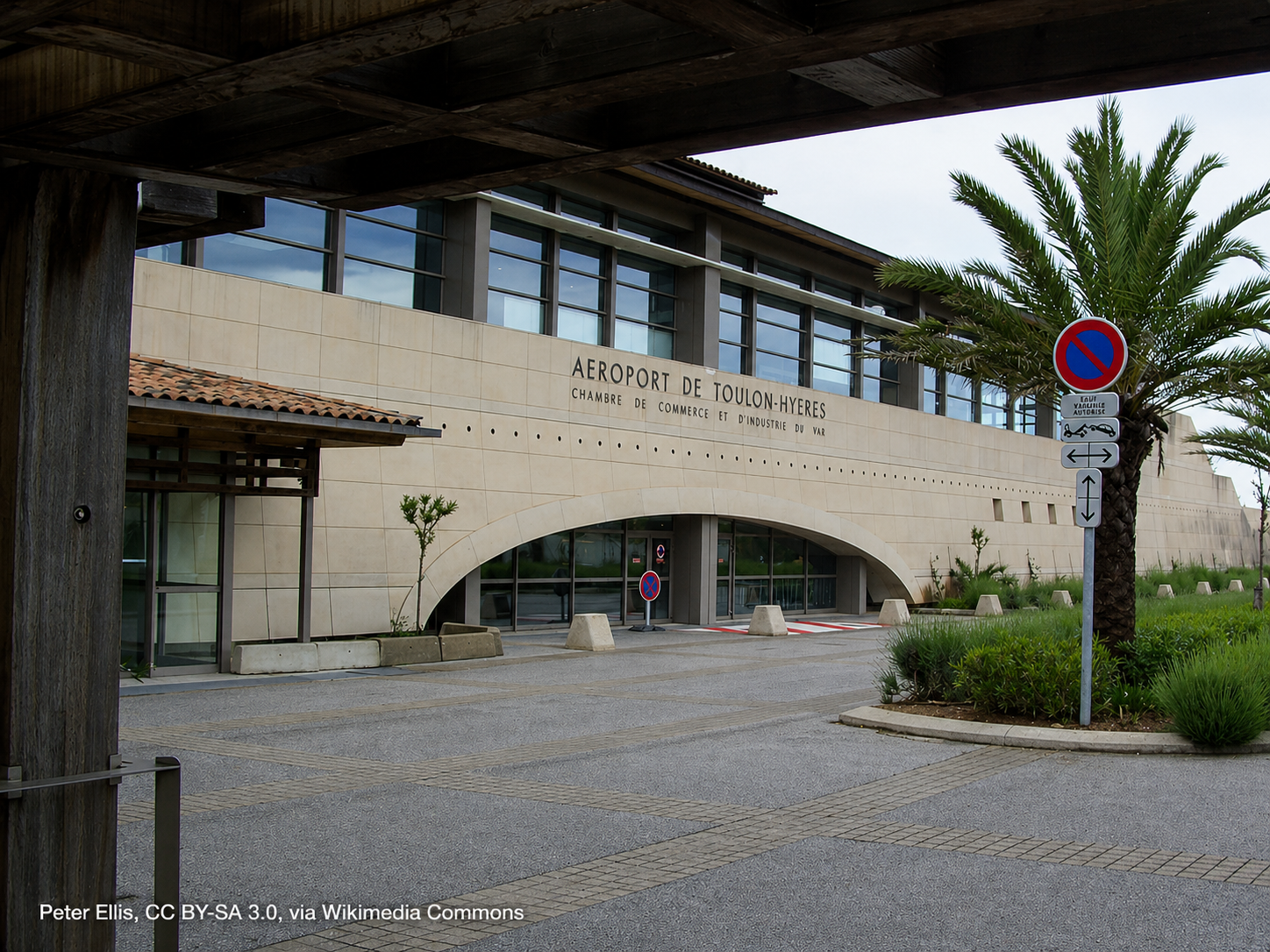
Airport Overview
Toulon–Hyères Airport is located just 3 kilometres from Hyères and approximately 20 kilometres from Toulon, placing it within immediate reach of the western Mediterranean coastline.
The airport serves a region that is both geographically compact and logistically sensitive. Coastal roads, seasonal traffic, and distributed destinations mean that proximity to the point of arrival becomes a decisive factor in overall journey efficiency.
From a structural perspective, the airport operates within a dual-use framework, supporting both civil and military aviation. This introduces an additional layer of coordination, particularly in terms of airspace management and runway usage.
Operationally, this translates into:
- Defined but manageable traffic flows
- Controlled ground operations
- Predictable turnaround environments
Unlike larger Riviera airports, where movement is shaped by volume, Toulon’s operations are shaped by coordination.
In real-world charter scenarios, this distinction becomes particularly valuable for clients seeking timing accuracy and reduced exposure to delays.
General facts about Toulon–Hyères Airport (LFTH)
| Fact | Details |
|---|---|
| ICAO Code | LFTH |
| IATA Code | TLN |
| Location | Toulon / Hyères, France |
| Airport Type | International, Civil + Military |
| Elevation | 13 ft / 4 m |
| Runways | 1 |
| Runway Length | 2,120 m / 6,955 ft |
| Slot Coordination | Not slot-restricted |
| Customs Availability | Yes (with prior arrangement) |
Private Aviation at Toulon–Hyères Airport (LFTH)

Dedicated FBOs
Handling at Toulon–Hyères is integrated into the airport’s business aviation infrastructure, with operations centred around a dedicated terminal environment rather than multiple independent FBO operators.
At Toulon–Hyères Airport, business aviation handling includes:
- Toulon–Hyères Business Aviation Terminal
Full FBO / Handling Address (Operational Reference):
Airport Authority
Boulevard de la Marine
Terminal Affaire
83400 Hyères (Toulon)
Francia
The business aviation terminal supports:
- Aircraft handling and apron coordination
- Passenger processing in a dedicated environment
- Crew services and operational support
- Fueling and ground handling
From an operational perspective, centralised handling introduces a higher degree of control.
Passenger movement is direct and uninterrupted, with minimal transition between landside and airside areas. Ground operations are typically efficient, particularly outside peak summer windows.
However, the presence of military activity requires alignment with broader airport operations, particularly in terms of runway access and scheduling.
Our aviation specialists at Zadra Aviation Charter coordinate closely with airport authorities to ensure that:
- Aircraft arrival is synchronised with runway availability
- Passenger handling aligns with operational readiness
- Ground time is managed proactively
In real-world operations, this coordination layer is what defines the overall efficiency of the experience.

Runway Capabilities
Toulon–Hyères Airport operates a single runway (05/23) measuring approximately 2,120 meters.
On paper, this places the airport within the mid-range category of European runways. In practice, however, performance margins become a defining factor.
From an operational standpoint:
- Light and midsize jets operate with strong flexibility
- Super midsize aircraft require a performance evaluation
- Heavy jets are generally not suitable for standard operations
Key considerations include:
- Takeoff distance relative to aircraft weight
- Temperature-driven performance variation
- Fuel requirements for outbound routing
In real-world planning, this results in a more nuanced approach to aircraft selection.
Rather than defaulting to larger aircraft, operators often select aircraft that balance range, payload, and runway performance.
This is where operational experience becomes critical.

Why Charter to Toulon–Hyères
Toulon–Hyères is increasingly positioned as a strategic alternative within the Riviera, particularly for clients who value control over convenience.
The airport serves a region where access is often more important than visibility.
Key demand drivers include:
- Direct access to Saint-Tropez without routing through Nice
- Proximity to private villas and coastal estates
- Discreet entry into the western Côte d’Azur
From a client perspective, the advantages are tangible:
- Reduced exposure to congestion
- Shorter ground transfer times
- Greater scheduling flexibility
This makes Toulon particularly well-suited to clients operating on tight timelines or seeking a more controlled travel environment.

Ground Transportation
Ground transport at Toulon–Hyères is defined by proximity and simplicity.
Our aviation specialists at Zadra coordinate:
- Chauffeur-driven transfers
- Luxury vehicles for coastal travel
- Direct connections to marinas and private residences
Typical transfer times remain predictable:
- Hyères within minutes
- Toulon, approximately 20 minutes
- Saint-Tropez approximately 45 to 60 minutes
From an operational standpoint:
Vehicle access is immediate at the business terminal
Low congestion allows rapid departure from the airport
This creates a seamless transition between air and ground segments of the journey.
Private Aviation at Toulon–Hyères Airport (LFTH)
Yes. It offers a more controlled operating environment with reduced congestion and faster handling.
Yes. Runway length and military coordination require careful planning.
Light and midsize jets provide the best balance of performance and flexibility.
Yes. Summer increases traffic, but operational pressure remains lower than at major Riviera hubs.


Apprezzato dai nostri clienti
4.9 / 5
Sulla base di 1.328 recensioni verificate
Ginevra 
ZUG
 Un'azienda con sede in Svizzera
 Torna in alto