





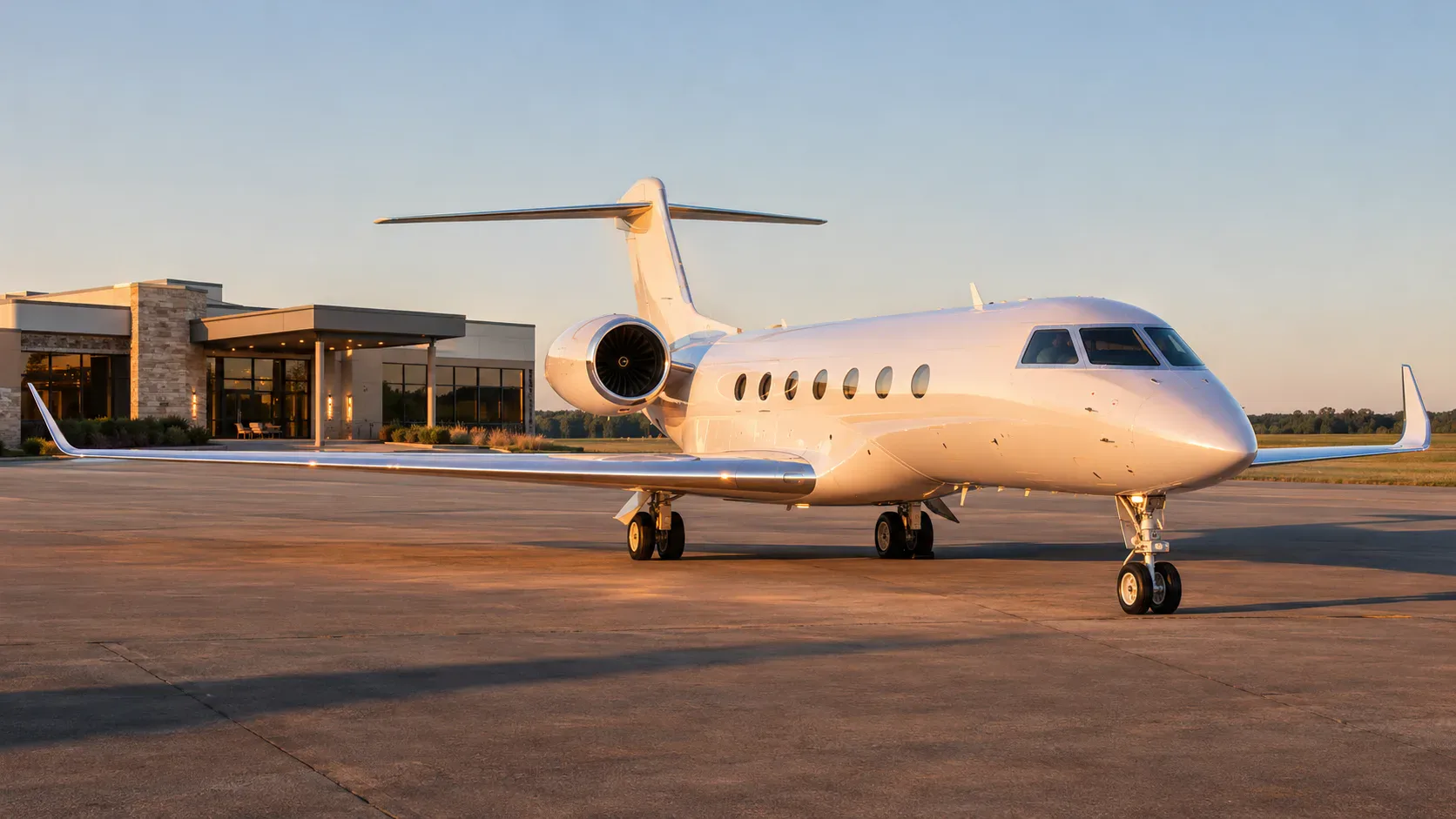
Every year, hundreds of millions of passengers pass through the busiest US airports. For airlines, these hubs are the backbone of the network. For private jet travellers, however, they are often the airports to avoid, or at least to understand before planning a trip.
In this guide, we look at the busiest US airports based on the latest official data, explain what makes them so busy, and show which smaller airports private jet passengers can use instead to save time.
How Are the Busiest US Airports Measured?
There are two common ways to rank airports. The US Federal Aviation Administration (FAA) counts enplanements, which means the number of passengers boarding a flight at each airport. Airports Council International (ACI World) counts total passengers, which includes both arriving and departing travellers, so its figures are roughly twice as high.
The ranking below uses the FAA final passenger data for 2025, published in September 2026. It is the most complete and official source for US commercial airports.
The 20 Busiest US Airports in 2026
| Rank | Aéroport | Code | City | Passengers boarded (2025) |
|---|---|---|---|---|
| 1 | Hartsfield-Jackson Atlanta International | ATL | Atlanta, GA | 51,459,786 |
| 2 | Dallas Fort Worth International | DFW | Dallas–Fort Worth, TX | 41,297,009 |
| 3 | Chicago O’Hare International | ORD | Chicago, IL | 40,680,735 |
| 4 | Denver International | DEN | Denver, CO | 39,976,695 |
| 5 | Los Angeles International | LAX | Los Angeles, CA | 36,497,303 |
| 6 | John F. Kennedy International | JFK | New York, NY | 30,792,806 |
| 7 | Orlando International | MCO | Orlando, FL | 27,999,709 |
| 8 | Harry Reid International | LAS | Las Vegas, NV | 26,531,765 |
| 9 | Miami International | MIA | Miami, FL | 26,450,972 |
| 10 | San Francisco International | SFO | San Francisco, CA | 26,251,850 |
| 11 | Charlotte Douglas International | CLT | Charlotte, NC | 25,873,555 |
| 12 | Seattle-Tacoma International | SEA | Seattle, WA | 25,417,071 |
| 13 | Phoenix Sky Harbor International | PHX | Phoenix, AZ | 25,094,817 |
| 14 | Newark Liberty International | EWR | Newark, NJ | 23,464,492 |
| 15 | George Bush Intercontinental | IAH | Houston, TX | 23,265,028 |
| 16 | Boston Logan International | BOS | Boston, MA | 21,021,153 |
| 17 | Minneapolis–St Paul International | MSP | Minneapolis, MN | 17,488,261 |
| 18 | Detroit Metropolitan Wayne County | DTW | Detroit, MI | 16,294,768 |
| 19 | LaGuardia | LGA | New York, NY | 16,278,532 |
| 20 | Fort Lauderdale-Hollywood International | FLL | Fort Lauderdale, FL | 15,646,752 |
Atlanta remains the busiest airport in the United States, and also the busiest in the world by total passengers, according to ACI World. Dallas Fort Worth, Chicago O’Hare and Denver complete the US top four, and all four are among the ten busiest airports worldwide.
A Closer Look at the Top 5
1. Hartsfield-Jackson Atlanta International (ATL)
Atlanta has been the busiest US airport for decades. Its success comes from its role as the main hub of a major US airline and from its location, as a large part of the US population lives within a two-hour flight. In 2025, more than 51 million passengers boarded a flight there.
2. Dallas Fort Worth International (DFW)
Dallas Fort Worth is one of the largest airports in the world by land area, larger than the island of Manhattan. Its central location makes it an ideal connecting point between the East and West Coasts, as well as for flights to Latin America.
3. Chicago O’Hare International (ORD)
O’Hare was one of the fastest-growing airports in the top five in 2025, with passenger numbers up by more than 5% compared with 2024. It is a key hub for both domestic and long-haul international flights.
4. Denver International (DEN)
Denver is the largest airport in North America by land area and a major gateway to the Rocky Mountains. In winter, it is also the arrival point for many travellers heading to ski resorts such as Aspen and Vail.
5. Los Angeles International (LAX)
LAX is the busiest airport on the West Coast and one of the main gateways between the United States and Asia-Pacific. It is also known for heavy traffic around the terminals, which is why many private travellers choose nearby business aviation airports instead.
Why Private Jet Travellers Often Avoid the Busiest US Airports
Large hubs are designed for airlines, not for private aviation. As a result, private jet passengers usually prefer smaller airports nearby, for several reasons:
- Less congestion: fewer airline flights mean shorter waiting times for take-off and landing slots.
- Faster access: smaller airports are often closer to business districts and residential areas.
- Dedicated terminals: private terminals (FBOs) allow passengers to arrive shortly before departure and go directly to the aircraft.
- Lower fees: landing and handling fees are often lower than at the largest hubs.
Private Jet Alternatives to the Busiest US Airports
Most major US cities have at least one airport that is better suited to private aviation. The table below shows some of the most popular options.
| Major hub | Private jet alternative | Why it helps |
|---|---|---|
| Atlanta (ATL) | DeKalb-Peachtree (PDK) | Around 30 minutes north of Atlanta’s business districts |
| Dallas–Fort Worth (DFW) | Dallas Love Field (DAL), Addison (ADS) | Closer to central and north Dallas |
| Chicago (ORD) | Chicago Executive (PWK), Midway (MDW) | Less congestion and quicker access by car |
| Denver (DEN) | Centennial (APA) | Convenient for the Denver Tech Center and mountain trips |
| Los Angeles (LAX) | Van Nuys (VNY) | One of the busiest business aviation airports in the world |
| New York (JFK, EWR, LGA) | Teterboro (TEB), Westchester County (HPN) | Teterboro is around 12 miles from Midtown Manhattan |
| Las Vegas (LAS) | Henderson Executive (HND) | Quieter, with fast access to the Strip |
| Miami (MIA) | Opa-locka Executive (OPF) | Dedicated business aviation facilities |
| Houston (IAH) | William P. Hobby (HOU), Sugar Land (SGR) | Closer to downtown and the southwest suburbs |
| Boston (BOS) | Hanscom Field (BED) | A popular alternative for the Greater Boston area |
The right choice depends on the final destination, the aircraft and the time of day. For example, some smaller airports have shorter runways, which may limit the size of the aircraft, while others have opening hours or noise restrictions. You can read more about this in our guide to airport categories.

Flying to the United States by Private Jet
For flights from Europe to the United States, long-range jets can fly non-stop from Switzerland to destinations such as New York, Miami or Los Angeles. Passengers clear US customs and immigration on arrival, either at the first airport of entry or, in some cases, through a pre-clearance facility. Private terminals make this process faster and more discreet than at a commercial terminal.
When choosing the aircraft, range and cabin size are the key factors. A transatlantic flight requires a long-range jet, while flights within the United States can often be done with a midsize or super-midsize jet. Our guide to jets vs. turboprops explains the main differences between aircraft types.
Plan Your Private Flight to the United States
Whether you are flying to a major city or a smaller regional airport, Zadra Aviation Charter helps you choose the most convenient airport and the right aircraft for your trip, so you can avoid the crowds of the busiest US airports and travel on your own schedule.
Planning a trip to the United States? Contact Zadra Aviation Charter to receive a tailored private jet charter quote.

Postes connexes
The Busiest US Airports 2026
A ranking of the 20 busiest US airports based on the latest official FAA data, plus the private jet alternatives near each major hub.
The Busiest US Airports 2026
A ranking of the 20 busiest US airports based on the latest official FAA data, plus the private jet alternatives near each major hub.

 Une entreprise basée en Suisse
